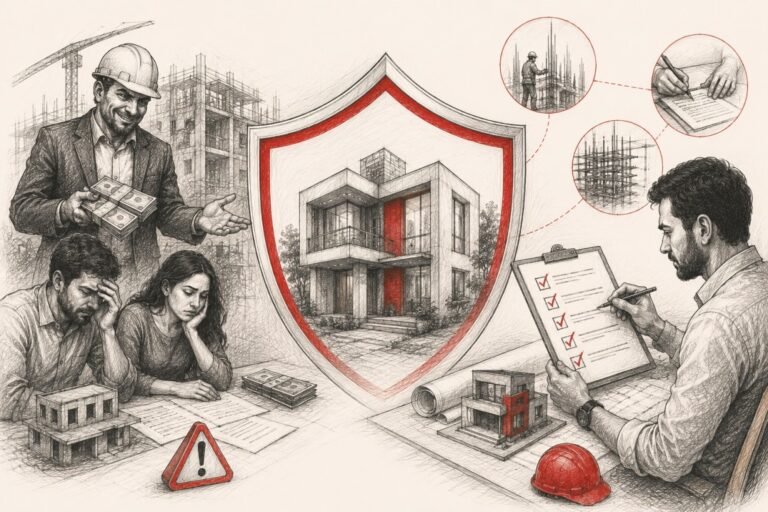
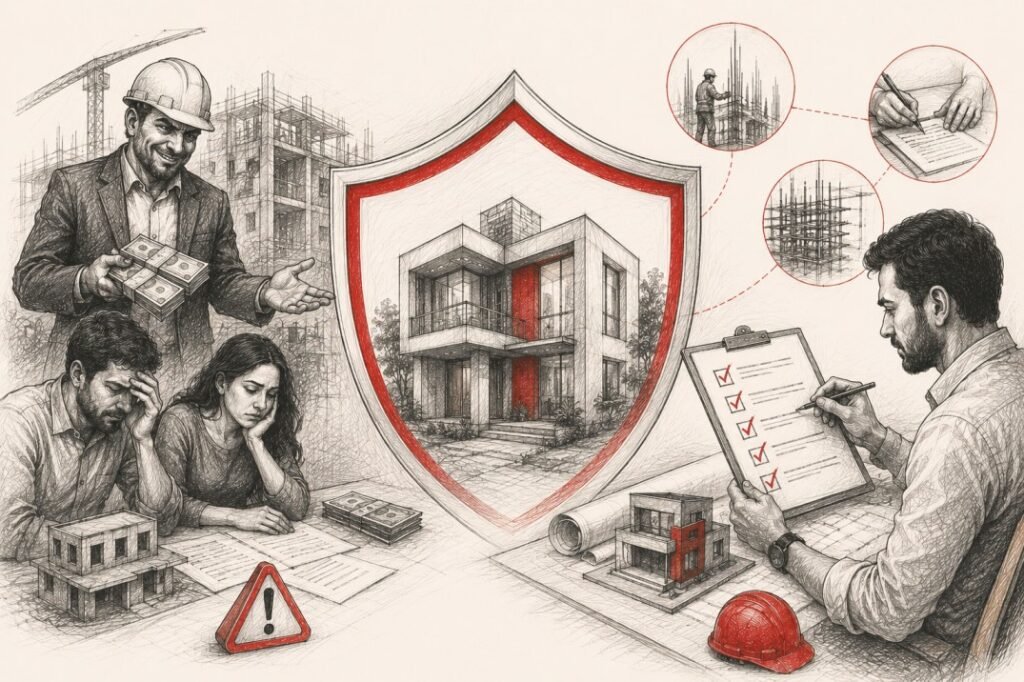
How to Avoid Getting Cheated by a Builder: A Hyderabad Homeowner’s Guide
Building a home is the biggest financial decision most families in Hyderabad will ever make and the one they’re least prepared for. You’re trusting someone with years of savings, on a process you can’t fully see, using materials you can’t fully judge. It’s no wonder the fear of being cheated keeps people up at night.
Here’s the good news: almost every way a homeowner gets cheated is preventable if you know what to look for before you sign, not after. This guide walks you through exactly that.
“I grew up on my father’s construction sites. Between us, over forty years, we’ve built more than four hundred homes and I’ve watched families get the exact house they paid for and still feel robbed, because nobody ever showed them where their money went. The cheating isn’t always in the bricks. It’s in the dark.” Ashok Aryan, Founder, Trega Constructions
First, the uncomfortable truth
Most “cheating” in home construction isn’t a dramatic disappearance with your money (though that happens too). It’s quieter: a slightly cheaper grade of steel you’ll never see inside the concrete. A bill that never arrives. A round-figure “extra” added halfway through. A timeline that slips with no consequence.
None of it looks like fraud in the moment. It looks like normal building. That’s exactly why it works and why your protection has to be built in advance, into your agreement, not chased afterwards through years of stress.
How to avoid getting cheated by a builder: the 8 traps, and how to stop each one
1. The large upfront advance
The trap: A builder asks for a big advance “to start.” Once a large sum is paid before any work exists, the leverage shifts entirely to them and some never return to the site at all. Your protection: Never pay ahead of work. Tie every payment to a completed, verified stage. You should be paying for work that’s done and checked, not work that’s promised.
“Ask one question: why does a builder need a big advance before he’s laid a single brick? A fair builder is paid for work that’s done and verified not for work he’s promising to do. We flipped that on purpose.” – Ashok Aryan
2. The vague, one-sided agreement
The trap: A thin agreement with no fixed price, no clear scope, and no timeline written to favour the builder. When everything is loose, every dispute later goes their way. Your protection: Get a detailed written scope, a fixed price, and a stage-wise timeline all signed before work begins. A handshake and a verbal estimate are not a contract.
3. The disappearing bills
The trap: You pay for materials and labour but never receive itemised bills so you can never tell what was actually bought, at what price, or whether a margin was hidden inside a round figure. Your protection: Insist on a documented bill for every material and labour cost. A builder who won’t show you the bills is telling you something.
4. The material swap
The trap: You’re billed for a premium grade of cement, steel, or fittings and a cheaper grade goes in where you can’t see it. This is one of the most common and best-documented construction frauds. Your protection: Specify brands and grades in writing, and check deliveries against the spec. Better still, have your own technical person verify materials at key stages.
5. The hidden quality cuts
The trap: The cuts you can’t see are the dangerous ones less steel than designed, a weaker cement ratio, skipped curing time, missing waterproofing. The house looks fine on handover and fails years later. Your protection: This is where an independent set of eyes matters most. You have every right to appoint your own architect or engineer to inspect structural work at each stage before it’s covered up.
“The strongest line I can give a client isn’t ‘trust me.’ It’s ‘bring your own CA, bring your own architect, and check me before you pay.’ After fifteen years, that’s the only promise I’ve found worth making.” – Ashok Aryan
6. The “we’ll adjust it later” cost creep
The trap: An attractive low quote to win you, then a steady drip of “unavoidable” extras until the final cost is far above what you agreed. Your protection: Lock the price at signing, and make the contract say plainly that the agreed figure is final barring changes you request in writing. No open-ended clauses.
7. The endless delay with no consequence
The trap: Months of slippage explained away by “material shortages” and “labour issues,” with no penalty because the builder bears no cost for being late, only you do. Your protection: Put a delay penalty in the contract ideally at every stage, not just final completion, so slippage is caught early when it can still be fixed.
8. The “just trust me”
The trap: A builder who resists every check no independent inspection, no third-party verification, no outside CA looking at the bills and asks you to simply trust him. Your protection: Reverse it. The right to verify, written into your agreement, is worth more than any reassurance. A builder confident in his work welcomes the check.
Questions to ask any builder before you sign
Take this list to every builder you meet. How they answer tells you more than their brochure:
- Is the price fixed and final once we sign or an estimate that can change?
- Is the full scope of work documented and signed before you start?
- Will I get an itemised bill for every material and labour cost?
- Are payments tied to completed, verified stages and how much do you want upfront?
- Can I appoint my own CA and architect to verify the work and the bills before I pay?
- Is there a penalty if you run past the timeline and is it stage-wise or only at the end?
- Which brands and grades of materials are you quoting, in writing?
- Can I speak to families whose homes you’ve already built?
A builder who answers all of these comfortably is rare. That’s exactly the point.
A myth worth clearing up: RERA probably won’t save you
Many homeowners assume a regulator has their back. It’s worth knowing the truth: RERA largely governs promoters and developers selling flats and plotted developments it generally does not cover you hiring a contractor to build your own independent home on your own plot.
And recourse after the fact consumer court, a cheating complaint is real but slow, expensive, and exhausting, often dragging on for years while you live in a rented house and an unfinished home.
The takeaway isn’t pessimism. It’s focus: your real protection is your contract and your verification rights, agreed before the first brick not a regulator or a court afterwards.
How Trega is built so you don’t have to worry
We’ll be direct about our own perspective here, because it’s the reason Trega exists.
Everything on the checklist above we didn’t just agree to it. We built our entire company around it, in writing, on every project:
- One price, locked at signing. What’s on your signed document is final. No “adjust later.”
- Payments tied to verified work never a large advance for work that doesn’t exist yet.
- A bill for every rupee materials and labour, documented and handed to you.
- Two live updates a day on WhatsApp or we pay you ₹3,000 for every update we miss.
- A 1.5% penalty for every stage we run late not just the final deadline, so slippage is caught early.
- The founder on your site every day it’s under construction.
- Your own CA and architect, welcome to verify the work and the bills before you release any payment. We don’t just allow it we recommend it.
We didn’t invent new promises. We took every protection a careful homeowner should demand, built it into how we work, and then handed you the keys to check it yourself. If you’d like to see what that looks like in practice, our [Turnkey Home Construction] and [Construction Management] pages lay it out and if you’re building from abroad, [NRI Home Construction] shows how the same checks work across any distance.
“You shouldn’t have to trust your builder. You should be able to check him. Build that into your contract with us or with anyone and you’ve protected yourself better than any promise ever could.” Ashok Aryan, Founder, Trega Constructions
Frequently asked questions
How do I avoid being cheated by a builder in Hyderabad?
Insist on a fixed written price, pay only for completed and verified stages (never a large advance), demand an itemised bill for every cost, and keep the right to have your own CA and architect check the work before you pay. Put all of it in a signed agreement before work begins.
Should I pay a large advance to a builder?
No. Large advances shift all the leverage to the builder and are a common feature of construction fraud. Tie payments to verified, completed stages instead, with only a reasonable mobilisation amount upfront.
How do I check that my builder is using the right materials?
Specify brands and grades in writing, check deliveries against that specification, and appoint your own architect or engineer to verify materials and structural work at each stage before it’s covered up.
Does RERA protect me if I build my own house?
Generally no. RERA mainly covers promoters and developers selling flats or plotted developments. If you’re hiring a contractor to build your own independent home, your protection comes from your written contract and your verification rights, not from RERA.
What should a construction agreement include?
A detailed scope of work, a fixed price, a stage-wise payment schedule tied to verified progress, a stage-wise delay penalty, specified material brands and grades, and your right to independent verification of work and bills before payment.
Building soon, and want to do it the safe way?
Take this checklist to any builder you meet and if you’d like to see a company that already answers “yes” to every question on it, talk to us.