What Is a Fixed-Price Construction Contract? And Why It’s the Only Way to Build Without Fear
If you’ve spoken to more than one builder in Hyderabad, you’ve probably heard the word “estimate.” A figure quoted confidently in the first meeting, put on a piece of paper, and presented as the cost of your home.
The problem is that an estimate is not a price. It’s a starting point.
A fixed-price contract is something different and for most families building in Hyderabad, understanding the difference is the single most important thing they can do before signing anything.
“In fifteen years, I’ve seen families go into construction with a number in their head and come out having paid 30 to 40 percent more. Almost every time, the reason was the same: they signed an estimate, not a fixed price. Those are not the same document.” – Ashok Aryan, Founder, Trega Constructions
What a fixed-price construction contract actually means
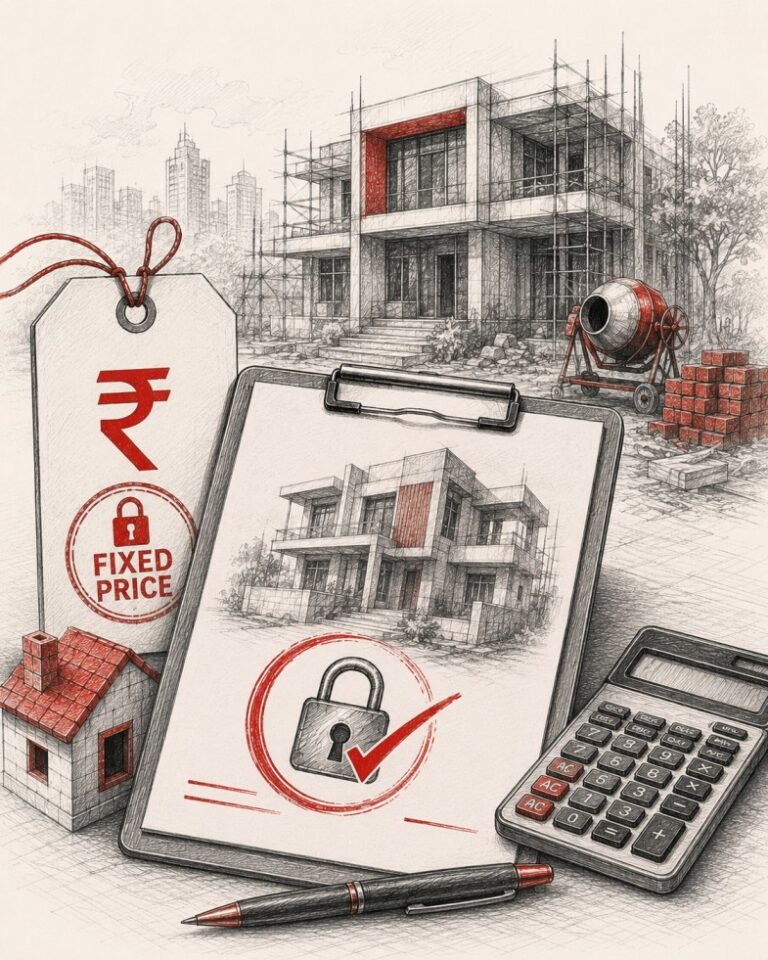
A fixed-price contract sometimes called a lump-sum contract sets one number for the complete scope of work, agreed and signed before construction begins. That number is final. It does not change because:
- Steel prices went up in month three
- Labour costs increased during monsoon
- The builder “forgot” to include something in the original quote
- Materials were more expensive than the builder estimated
All of those risks sit with the builder, not with you. You agreed to a number. That is the number you pay.
For a homeowner, this means one thing above all others: you can plan. You know, before a single brick is laid, exactly what your home will cost. You can arrange your finances around a real number, not a moving target.
What a fixed-price contract is NOT
This is where most confusion happens and where some builders deliberately blur the line.
It is not a fixed estimate. An estimate, even a detailed one, is the builder’s best guess at the cost. It is not a commitment. It can and usually does change.
It is not a “price subject to market rates.” Any clause that ties the final price to market fluctuations in materials or labour is not a fixed price. If steel goes up 15%, you pay 15% more that’s not fixed.
It is not a fixed price if it doesn’t cover the full agreed scope. If the contract lists exclusions vaguely (“finishes not included,” “electrical by separate quote”), the “fixed” price is only partially fixed. The rest will come back as extras.
It is not a fixed price if it can be varied without your written approval. Any contract that allows the builder to raise costs for “unforeseen circumstances” without your explicit written agreement is not fixed — it just looks like it.
“The most common trick I’ve seen is a builder quoting a fixed price on civil work only, and leaving finishes, electrical, plumbing, and fittings as ‘actuals.’ By the time the house is done, those ‘actuals’ are 40% of the total cost. It’s not a fixed price. It’s a fixed opening chapter with an open ending.” – Ashok Aryan
Fixed price vs. cost-plus: what’s the difference?
There are two main contract types in residential construction. Understanding both helps you know what you’re signing.
Fixed price (lump sum): One agreed number for the complete scope. The builder’s risk. You pay what was agreed.
Cost-plus (open book): You pay the actual cost of materials and labour, plus a percentage or fixed fee for the builder’s profit and overhead. The builder’s cost is transparent, but the total is unknown until completion.
Cost-plus has genuine advantages in some situations it’s transparent on costs and the builder has less incentive to cut quality to protect margins. But for most individual homeowners in Hyderabad, cost-plus carries a serious risk: there is no ceiling. If materials cost more, if the project takes longer, if the builder’s estimate of quantities was wrong you pay for all of it.
A fixed price removes that uncertainty. It transfers the risk of cost overruns from you to the builder. For a family building their first home with a defined budget, that risk transfer is enormously valuable.
What must be in a fixed-price contract to make it real
A fixed price is only as strong as what surrounds it. Without these elements, the number on the page is not actually fixed:
A complete, signed scope of work. Every item of work that is included and every item that is excluded must be documented and signed before work begins. A fixed price on a vague scope is not fixed; it just pushes the argument to later.
A material specification sheet. Every material by brand, grade, and specification. Without this, the builder can use cheaper materials and still claim the work is “complete.” A named material spec is what makes the fixed price real on the ground.
No open-ended variation clauses. The contract must state clearly that price changes require a signed written variation order from both parties. Verbal changes, “we’ll sort it later” adjustments, and unilateral increases are not permitted.
A stage-wise payment schedule. Payment tied to completed, verified work — not to the builder’s cash flow needs. A fixed price paid largely upfront defeats the purpose; the leverage disappears.
A delay penalty. If the builder can run late without consequences, the fixed price protects your money but not your time. A real fixed-price contract includes a penalty the builder pays for every stage they miss — not just the final deadline.
“When we put together a fixed-price contract at Trega, we spend time on the scope document before we ever agree on the number. The scope has to be complete and specific, because the price is only as reliable as the scope underneath it. A fixed price on a vague scope is not a promise — it’s a starting point for a later argument.” – Ashok Aryan
The questions to ask any builder about their fixed price
Not every builder who says “fixed price” means it the way you need them to mean it. Before you sign, ask these specifically:
- Is the price fixed including materials, labour, and all finishing or is anything quoted as “actuals” or “as per market rate”?
- What is the complete list of inclusions and exclusions in writing?
- What materials are specified, and by which brand and grade?
- If steel or cement prices increase during construction, who bears that cost?
- Can the price change without my written approval?
- Is there a delay penalty if you run late and does it apply to every stage, or only final completion?
A builder confident in their fixed-price commitment answers all of these without hesitation. Hedging, vague answers, or “we’ll work it out” on any of these questions means the price is not truly fixed.
How Trega’s fixed-price contract works
At Trega, the fixed price is not a marketing line. It is a contractual commitment with specific, enforceable terms:
- One price, on the signed document, is the final price. No revised estimates. No second invoice. No mid-project “market rate” adjustments.
- Every inclusion and exclusion is documented in a signed scope of work before construction begins.
- Every material is named in a signed specification sheet brand, grade, and standard.
- Payment follows verified work, not the builder’s schedule. You confirm each stage before money is released.
- A 1.5% penalty applies to every stage we run late not just the final deadline. Stage by stage, delays are our cost, not yours.
- You are welcome to appoint your own CA and architect to verify the work and the bills before any payment. We recommend it.
The fixed price is the foundation. Everything else in our system — the daily updates, the bill documentation, the independent verification — is what makes it real and checkable rather than just promised.
→ Turnkey Home Construction: see the full fixed-price process → Construction Management: fixed-price on your design
One honest thing about fixed-price contracts
A fixed price protects you from cost overruns but it also means the builder has to protect their margin by managing costs carefully. In the wrong hands, this creates an incentive to cut quality where you can’t see it: cheaper steel inside the concrete, thinner plaster, skipped waterproofing layers.
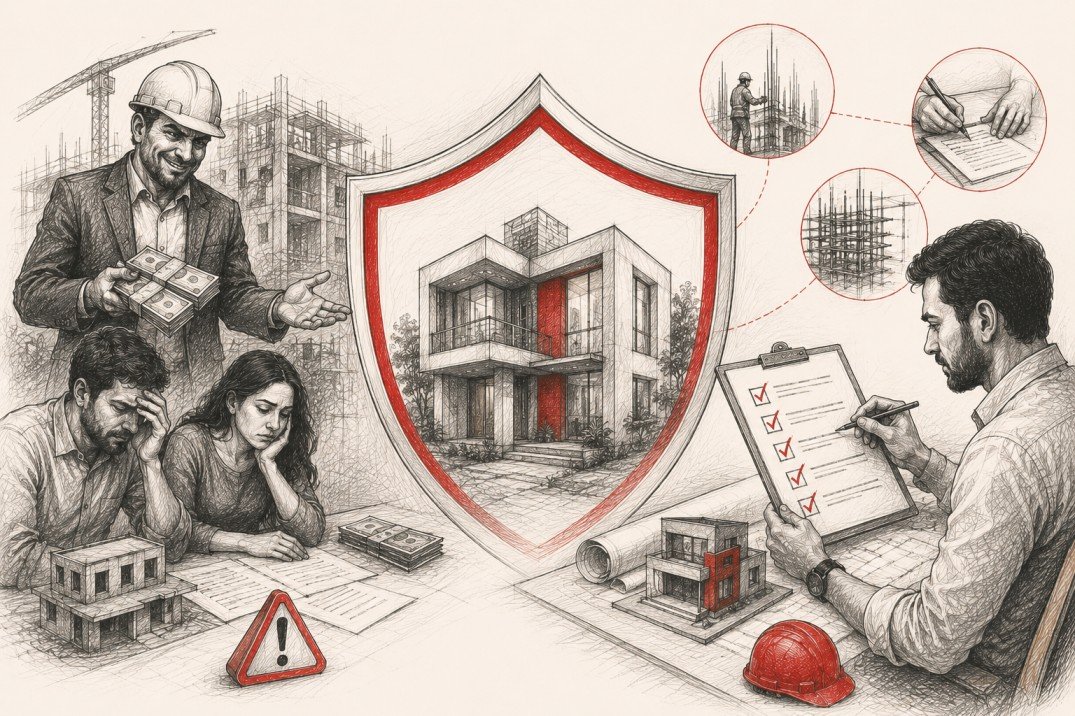
This is why a fixed price needs the full system around it specifically, the right to independent verification at every stage. If you can bring your own technical professional to inspect the work and the materials before each payment, a fixed price and independent verification together make construction genuinely safe. Neither one alone is enough.
A fixed price without verification is a promise. A fixed price with verification is proof.
“A fixed price is the starting condition, not the complete protection. The complete protection is a fixed price, a material spec, stage-wise verified payments, and the right to bring your own CA and architect to check us at every point. Those four together are what removes the fear. Not any one of them alone.” – Ashok Aryan, Founder, Trega Constructions
Frequently asked questions
What is a fixed-price construction contract?
A fixed-price construction contract sets one total price for the complete agreed scope of work, signed before construction begins. That price cannot be changed without a written variation order signed by both parties. The builder absorbs cost overruns; the client pays the agreed number and nothing more.
Is a construction estimate the same as a fixed price?
No. An estimate is the builder’s projection of likely costs it can and usually does change during construction. A fixed-price contract is a legal commitment that the total cost will not exceed the agreed number for the agreed scope. They are fundamentally different documents with very different risks for the homeowner.
What happens if material prices increase during construction?
In a genuine fixed-price contract, the builder absorbs material price increases. They quoted a number knowing the project would take several months; the risk of price movement during that period belongs to them, not to the client.
Can a fixed-price contract change at all?
Yes but only if the client requests a change to the scope of work, and only after both parties sign a written variation order agreeing the new price for that change. No other cost increase is valid in a genuine fixed-price contract.
What should I check to make sure a fixed price is real?
Check that the contract covers the complete scope including finishes, electrical, and plumbing. Check that all materials are specified by brand and grade. Check that no clause allows the builder to adjust the price for market rates or unforeseen circumstances without your written approval. And check that payments are tied to verified work, not the builder’s schedule.
Planning to build in Hyderabad and want to understand exactly how a fixed-price contract works in practice?
Talk to us – we’ll walk you through the complete document set before you commit to anything.
Book a free consultation
Read next: → How to avoid getting cheated by a builder · → How to choose a construction company: 7 red flags